

Take more bad photos.

During my Art 255 Photography 1 class in college, we were required to shoot at least 10 rolls of 36-exposure film a semester. That was the bare minimum, but that seemed like a lot at the time. For one thing, I had never shot a roll of 36-exposure film. That wants professionals used, right? The average person would buy a roll of 24-exposure from the store and shoot a couple of birthday parties, a graduation, a new car, and a flower in the backyard to finish off the roll and send it in to get developed months later. So how was I going to take that many photos? As I got into shooting for art class, I realized why we shot on roll 36-exposure film because I would take many bad photos.

Finding your voice.
Out of that roll of film, if I got one good photo I liked, I felt good. Above is the first roll of film from my Photography 1 class. You may notice only one red “x” on that sheet. That is my professor being very generous, marking the best shot on the roll. None of those photos made it to the final prints at the end of the year. In fact, it wasn’t until roll 10 that I had a photo that I’d end up in my final porfiolwasn’t this point in my career, I had no idea what images I wanted to capture or what I wanted to say. It wasn’t until I took those 10+ rolls of 36-exposure film that I found my voice.
Finding that one shoot.
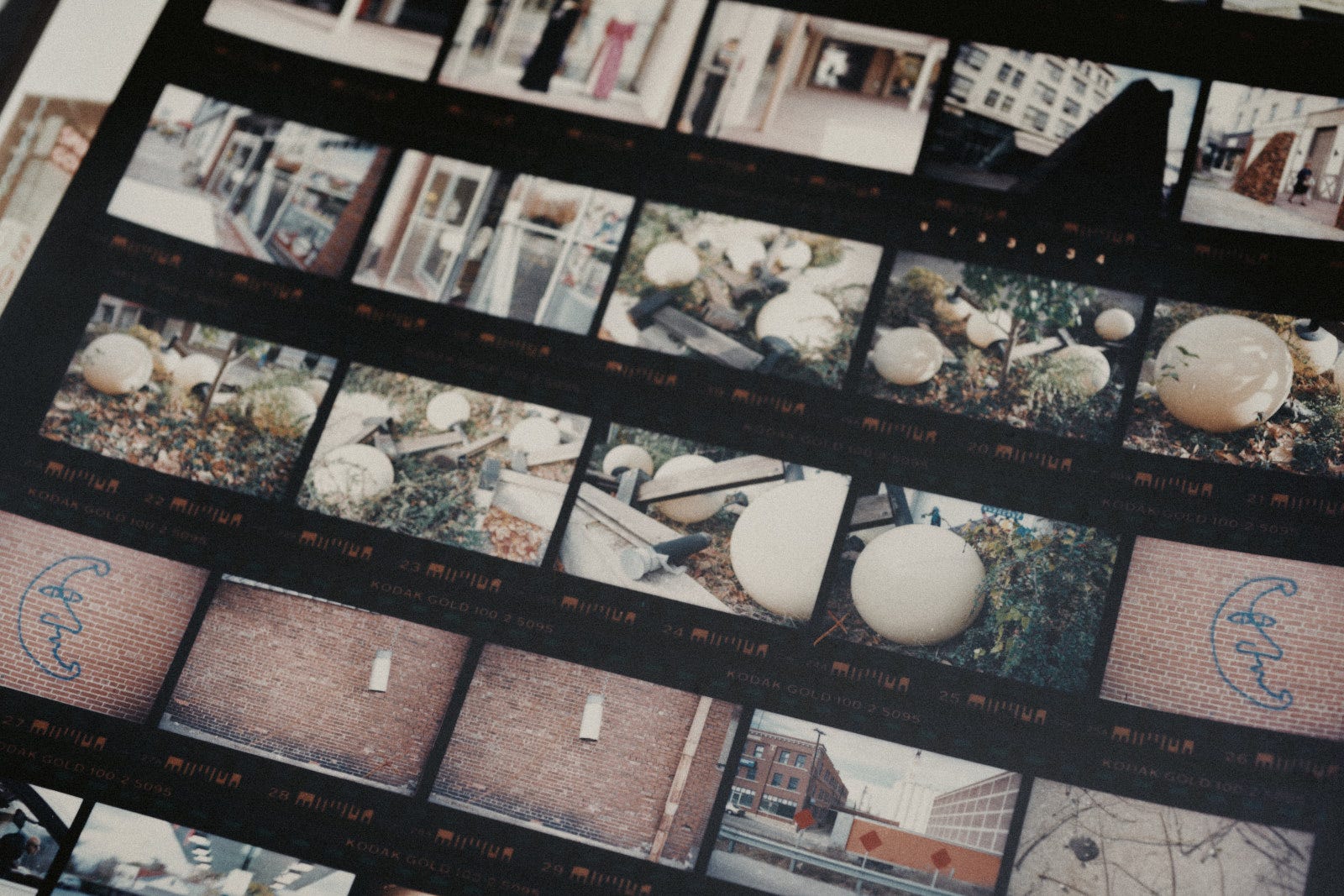
Sometimes, it just takes a while to find that perfect image. In the last post, I discussed two photos—the contact sheet above from the light fixture photo. If you look closely, you can see I took seven pictures of just this area. There was a good photo here in this pile of light fixtures; I just wasn’t sure where it was. That’s six bad images, not one good photo.
Sometimes, you know there is a good photo to be captured, but don’t if it doesn't jump out at you. Take your time, move around, get a different perspective, and don’t move on until you feel like you have it.

Capture those fleeting moments.
There are also those times when you don’t know what will happen. It may seem like a boring location, but there isn’t anything photogenic. On those days, it’s best to shoot whatever catches your eye. Most of those photos will be bad. But you might find one that is incredible. On the day I took the Poplar Bluff Sale Barn photo, the first image I took was the best for this roll of film. That moment happened in the blink of an eye. And it would never happen again unless I staged it. Of course, since it was on film, I had no idea what I had, so I continued to shoot the rest of the time, ending with 14 pictures from this location: one great, one ok, and 12 bad ones. But that’s ok. Taking bad photos helps train your eyes and mind to notice those moments that might be great.
So take the good and take the bad; that’s just the fact of life… in photography.*
*Sorry, that was pretty bad.